
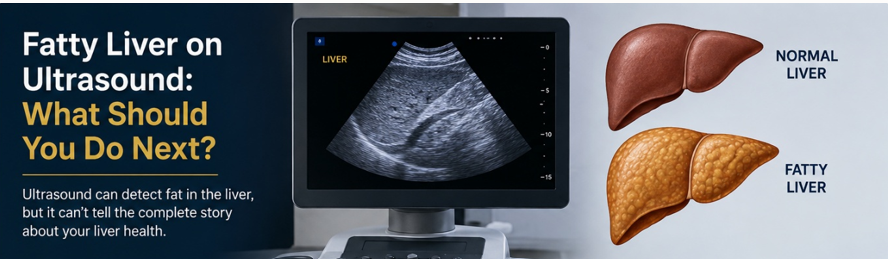
Being told that you have fatty liver on an ultrasound can be confusing. You may wonder: Is it serious? Do I need medicines? Can it be reversed? Do I need more tests?
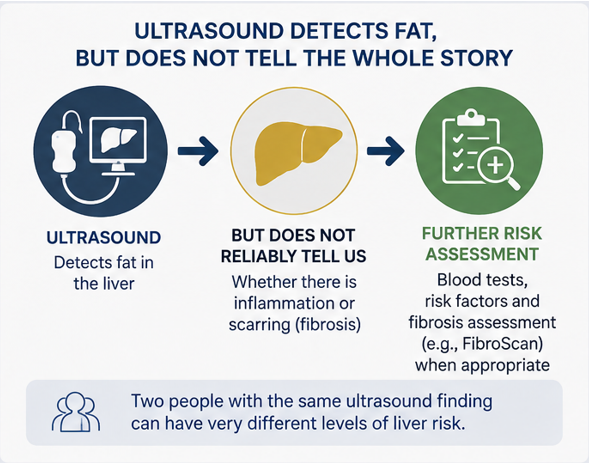
The first thing to understand is that an ultrasound can detect fat in the liver, but it cannot tell the complete story about your liver health.
What does fatty liver on ultrasound mean?
Fatty liver means that excess fat has accumulated in the liver. An ultrasound may describe this as Grade 1, 2 or 3 fatty liver which roughly corresponds to mild, moderate and severe amount of fat in liver. However, the amount of fat seen on ultrasound does not necessarily tell you whether your liver has inflammation or scarring (fibrosis).
A fatty liver may progress to inflammation (swelling in the liver), fibrosis (scarring in the liver) and eventually cirrhosis.
Two people with the same ultrasound finding can have very different levels of liver-related risk.
What should you do next?
Visit a Hepatologist/Liver doctor who will evaluate and stratify your liver health and risk and prescribe necessary medication if warranted.
How does a Hepatologists evaluate a Fatty liver?
Your hepatologist will usually
1. Look at your risk factors which include
- Excess weight or obesity
- Diabetes or insulin resistance
- High cholesterol or triglycerides
- High blood pressure
- Alcohol consumption
- Previous or current liver disease
These factors help determine your overall risk.
2. Check your blood tests
Liver blood tests such as ALT, AST, GGT and bilirubin may provide additional information. However, normal liver enzymes do not always mean that the liver is completely healthy.
3. Consider whether you need a fibrosis assessment
One of the most important questions after discovering fatty liver is: Does the liver have significant fibrosis or scarring?
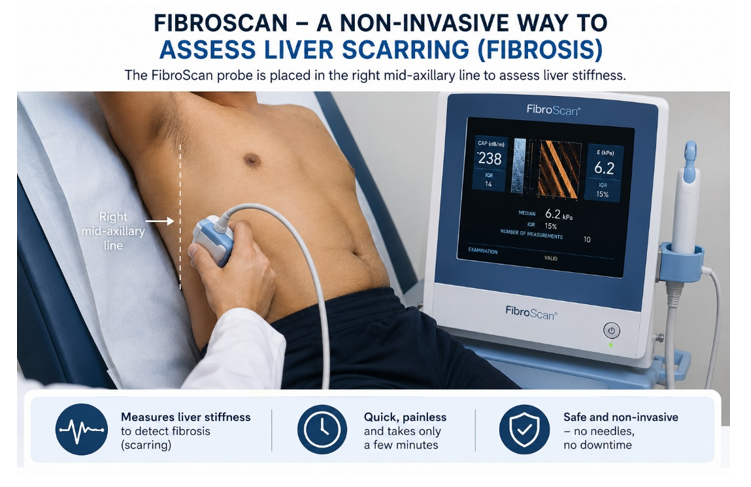
Depending on your age, medical history, blood tests and risk factors, your doctor may recommend a non-invasive fibrosis assessment such as FibroScan to assess whether significant liver scarring (fibrosis) is present and, if so, how advanced it may be.
4. Address the underlying causes
For many people, managing fatty liver involves improving metabolic health through weight management, regular physical activity, a balanced diet and control of conditions such as diabetes and high cholesterol.
Alcohol intake should also be avoided.
5. Consider medications when appropriate
If your evaluation shows significant liver disease or you have associated metabolic conditions, your hepatologist may consider medications.
The important takeaway
Fatty liver on ultrasound is a finding not the complete diagnosis.
Instead of focusing only on whether your report says “Grade 1,” “Grade 2,” or “Grade 3,” the next step should be understanding why you have fatty liver and whether there is any evidence of liver damage or fibrosis.
If you have recently been diagnosed with fatty liver and are unsure what your ultrasound or blood tests mean, Book a consultation with Dr Samriddhi Poyekar to understand your fatty liver and what you should do next.
Dr Samriddhi Poyekar
Consultant Hepatologist & Liver Transplant Physician