
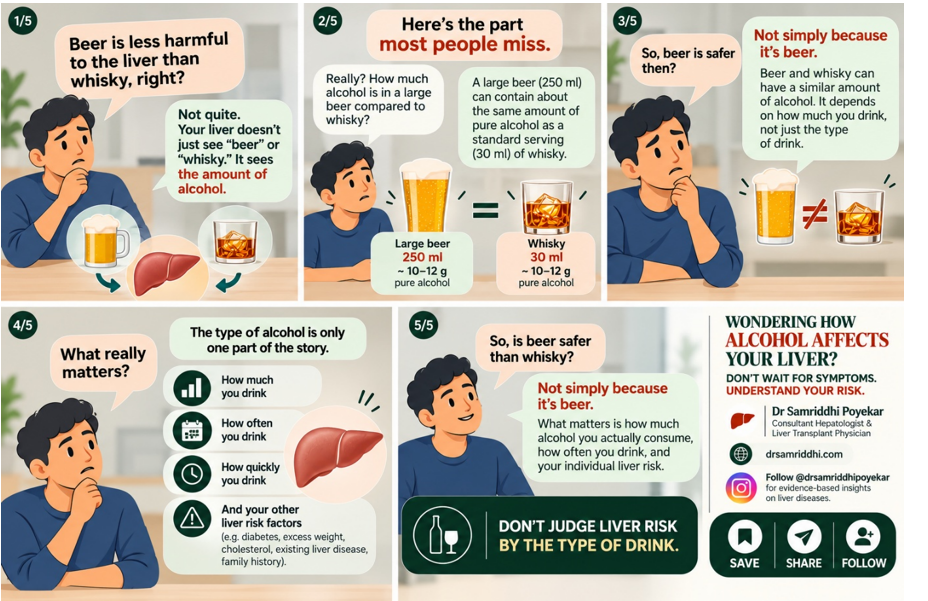
Short answer: Neither. Your liver doesn’t care whether alcohol comes from beer, wine or whisky. What matters is the total amount of pure alcohol you drink, how often you drink it, and your existing liver risk.
Is beer really safer for your liver than whisky?
You may have heard this before: “I drink beer, not whisky. So it’s less harmful to my liver.”
Unfortunately, it’s not that simple. Your liver doesn’t really care whether the alcohol comes in a beer bottle, a wine glass or a whisky glass. What matters is how much alcohol you actually consume.
How much alcohol is in beer, wine and whisky?
You don’t usually drink 30 mL of beer. A typical serving looks very different for each drink, yet the amount of pure alcohol can be surprisingly similar. A typical serving is about 250 mL of beer, 100 mL of wine, or 30 mL of whisky, vodka or gin.
For example: 250 mL of beer at 5% alcohol has about 10 g of pure alcohol. 100 mL of wine at 12% alcohol has about 9.5 g. 30 mL of whisky at 40% alcohol has about 9.5 g.
So a glass of beer isn’t automatically “lighter” on your liver just because beer has less alcohol per volume. The drink is bigger, but the amount of alcohol can be similar.
Why a full beer bottle adds up fast
In practice, many people don’t drink a 250 mL serving. A 650 mL bottle of 5% beer contains roughly 25 g of pure alcohol, which is more than two standard drinks. Strong beers contain even more.
So is beer safer than whisky?
Not necessarily. Whisky contains more alcohol per mL, but you usually drink much less of it. Beer contains less alcohol per mL, but you may drink a much larger volume.
What matters is the total amount of alcohol you consume, not simply the type of drink.
What decides your liver risk from alcohol?
Your risk of alcohol-related liver damage depends on how much you drink, how often you drink, whether you binge drink, whether you already have fatty liver or another liver disease, and your weight, diabetes and other metabolic risk factors.
For example, someone drinking several beers every weekend may have a very different liver risk from someone who occasionally has a small drink.
What does fatty liver on ultrasound mean?
Fatty liver means that excess fat has accumulated in the liver. An ultrasound may describe this as Grade 1, 2 or 3 fatty liver, which roughly corresponds to a mild, moderate or severe amount of fat in the liver.
However, the amount of fat seen on ultrasound does not necessarily tell you whether your liver has inflammation or scarring (fibrosis).
A fatty liver may progress to inflammation (swelling in the liver), fibrosis (scarring in the liver) and eventually cirrhosis. Two people with the same ultrasound finding can have very different levels of liver-related risk, and alcohol can add to that risk.
The takeaway
Don’t judge the effect of alcohol on your liver by the type of drink. Think about the amount of alcohol, how often you drink it, and your individual liver risk.
Beer isn’t automatically safer. Whisky isn’t automatically worse. It’s the alcohol that matters.
Frequently asked questions
Is beer safer than whisky for the liver?
Not necessarily. Your liver responds to the total amount of pure alcohol you drink, not the type of drink. A larger volume of beer can contain as much alcohol as a small measure of whisky.
How much alcohol is in one standard drink?
A standard drink contains roughly 10 g of pure alcohol. This is about 250 mL of 5% beer, 100 mL of 12% wine, or 30 mL of 40% whisky, vodka or gin.
Does grade 1 fatty liver on ultrasound mean my liver is healthy?
Not necessarily. The grade reflects how much fat is visible, but it does not show whether there is inflammation or scarring (fibrosis). Two people with the same ultrasound finding can have very different risk.
Can fatty liver progress to cirrhosis?
Yes. A fatty liver may progress to inflammation, then fibrosis (scarring) and eventually cirrhosis. Alcohol, obesity and diabetes can all increase this risk.
Worried about your liver?
If your ultrasound shows fatty liver or you drink regularly, a liver specialist can assess whether you have inflammation or fibrosis and advise you on alcohol. Consider booking a consultation with a hepatologist.
This article is for general information and is not a substitute for personal medical advice. Please consult your doctor about your own liver health and alcohol use.
Medically reviewed by Dr. Samriddhi Poyekar, Consultant Hepatologist & Liver Transplant Physician